Agroecology in Kenya: Meaning, Principles, Training & How G-BiACK Is Leading the Way in Sustainable Farming
In thousands of smallholder farms across Central, Eastern, and Rift Valley regions, decades of chemical-intensive farming have left the land exhausted — degraded soils, falling yields, rising input costs, and communities struggling to put food on the table. At the same time, climate change is making the rains unpredictable, droughts longer, and farming increasingly uncertain for the 6 million smallholder households that feed the country.
There is a better way. And it has a name: agroecology.
Agroecology in Kenya is not a new idea; Kenya’s grandmothers practised it before synthetic fertilisers arrived. But today, it is being reclaimed with scientific rigour, community commitment, and practical, hands-on training. At the forefront of this movement is the GROW BIONINTENSIVE Agriculture Centre of Kenya (G-BiACK), based in Thika — a community-driven training and demonstration campus that has spent over 15 years proving that ecological farming can feed families, restore land, create jobs, and build food sovereignty from the ground up.
Whether you are a smallholder farmer seeking affordable solutions, a young Kenyan looking for a future in agriculture, an NGO seeking agroecology partnerships, or simply searching for what agroecology actually means — this guide is for you.
What Is Agroecology? (Definition and Meaning in Agriculture)
What Is the Meaning of Agroecology?
Agroecology is the application of ecological principles to the design and management of agricultural systems. The word itself comes from three roots: agro (farming), eco (ecosystem), and logy (the study of). Put simply, agroecology treats the farm not as a factory but as a living ecosystem — one that should be understood, nurtured, and worked with, not against.
Unlike conventional farming, which relies heavily on external chemical inputs, monocultures, and yield-maximisation at environmental cost, agroecology integrates science, local knowledge, and social equity into every farming decision. It asks: How can we grow food in a way that feeds people today, while preserving the land and resources for the generations that come after us?
According to the Food and Agriculture Organisation (FAO), agroecology is simultaneously a science, a practice, and a social movement. Kenya’s own National Agroecology Strategy for Food System Transformation (2024–2033) formally defines it as an approach that “applies ecological principles to protect the long-term absorptive and adaptive capacity of the agroecosystem and regenerates farmers’ natural capital.”
For smallholder farmers in Kenya, the meaning is deeply practical: grow more food, spend less money on inputs, protect the soil, conserve water, and reclaim control over seeds and livelihoods.
What Are the Principles of Agroecology?
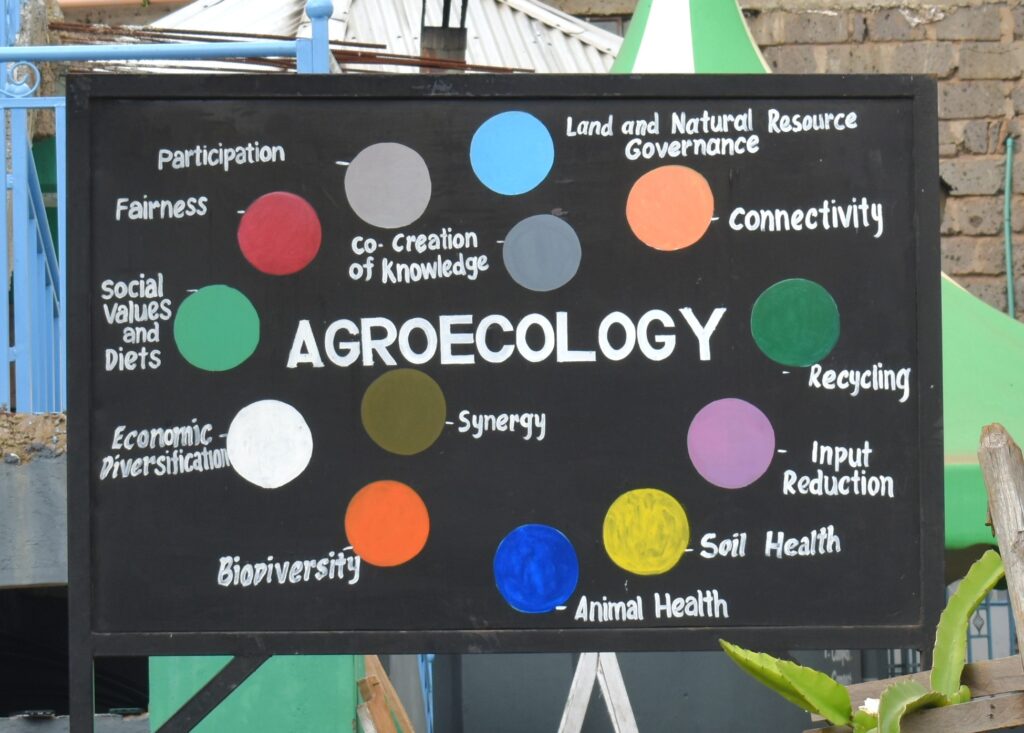
The FAO’s globally recognized framework identifies 13 interconnected principles of agroecology. Here is how they apply in a Kenyan context:
- Recycling — Use on-farm biomass, compost, and animal manure rather than purchased inputs
- Input Reduction — Minimize or eliminate synthetic fertilizers and pesticides
- Soil Health — Prioritize soil biology, organic matter, and microbial life
- Animal Health — Integrate livestock into the farming system ethically and sustainably
- Biodiversity — Cultivate diverse crops, trees, and animals within and around the farm
- Synergy — Design crop combinations that benefit each other (companion planting)
- Economic Diversification — Build multiple income streams from the farm ecosystem
- Co-Creation of Knowledge — Value farmers’ indigenous knowledge alongside scientific research
- Social Values & Diets — Reconnect people with nutritious, culturally appropriate local food
- Fairness — Ensure equitable access to land, seeds, water, and markets
- Connectivity — Link producers and consumers through short, transparent supply chains
- Land & Natural Resource Governance — Protect community rights over natural resources
- Participation — Ensure farmers — especially women and youth — lead decision-making
At G-BiACK, these are not abstract principles. They are lived daily across the Community Demonstration Farm, where farmers, trainees, and communities come to see, touch, and practice every one of them in action.
Agroecology vs. Regenerative Agriculture: What’s the Difference?
This is one of the most commonly searched questions, and the answer matters for Kenyan farmers and policymakers.
Regenerative agriculture is a practice-focused approach that emphasizes rebuilding soil health, increasing biodiversity, and restoring ecosystem function — typically through no-till farming, cover cropping, composting, and rotational grazing. It is widely promoted in commercial and export farming contexts.
Agroecology includes all of these practices but goes further. It is also a social and political framework — one that explicitly addresses food sovereignty, farmers’ rights, gender equity, indigenous knowledge, and the power dynamics within food systems. Agroecology asks not only how to farm better, but who controls the food system and whose knowledge counts.
In Kenya, a 2024 Regen10 convening noted that agroecology is “already widely practiced across Kenya,” but that policy coherence and farmer support remain critical gaps. Kenya’s National Agroecology Strategy (2024–2033) bridges both frameworks, providing direction for transitioning the national food system sustainably.
For smallholder farmers in Kenya, the practical difference is this: regenerative agriculture tells you to rebuild your soil. Agroecology tells you to rebuild your soil, protect your seeds, and reclaim your power in the food system.
How to Practice Agroecology in Kenya: The Grow Biointensive Method
Best Practices for Starting Agroecology on a Small Farm in Kenya
The most accessible, scientifically proven entry point into agroecology for smallholder farmers in Kenya is the Grow Biointensive (GBIA) method — a system researched over 50 years by John Jeavons and Ecology Action in California, and now deeply rooted in Kenyan communities through G-BiACK’s work in Thika, Kiambu, Muranga, and Machakos counties.
Here is what the Grow Biointensive method looks like in practice:
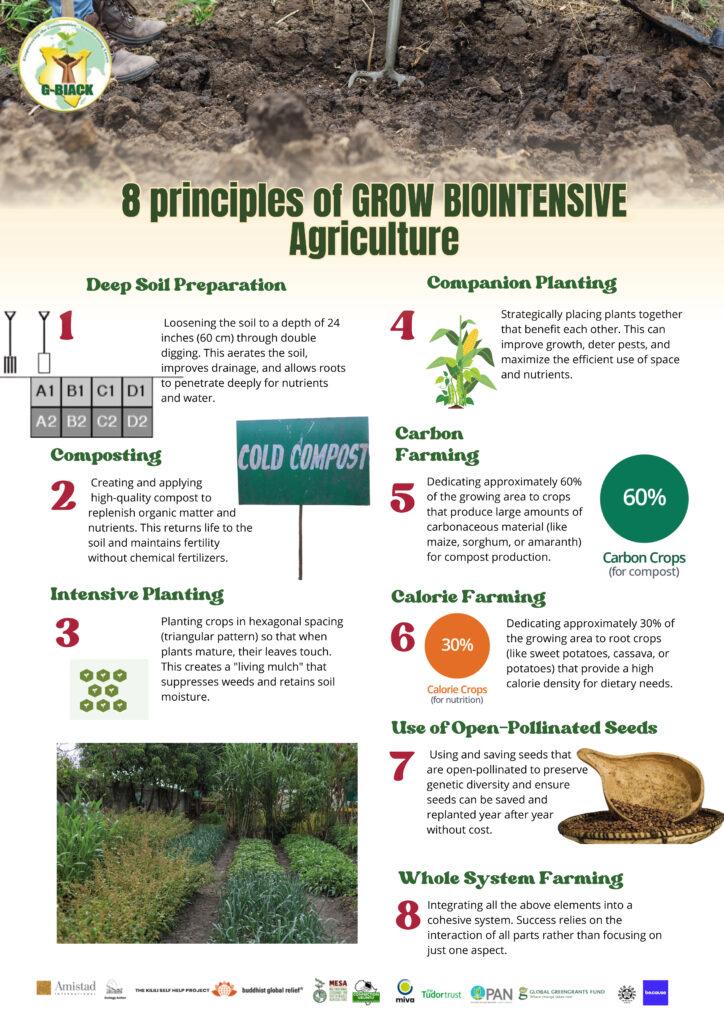
The results speak for themselves:
- 67–88% less water used compared to conventional farming
- 50–100% reduction in purchased fertilizer costs
- 2 to 6 times more food produced per unit of land
- 99% less energy than conventional agriculture
- Soil built up to 60 times faster than in nature
Patrick Muthemi, a farmer from Kitabasiye Community, survived the devastating 2017 drought because his soil had been built through five years of composting and cover cropping. “My farm actually produced a harvest,” he said. “Not a big one, but enough to feed my family and have something to sell. That’s when the whole community really took notice.”